Puget Sound Business Journal: Sept. 17-23, 2004
Suburbs see need to balance job growth and housing
By Brad Broberg
Contributing Writer
In their hunger for economic growth, suburban cities see jobs as red meat. The more employment cities bring to the table, the stronger they make their communities.
Here's the catch. To be truly healthy, cities must balance jobs with housing -- a balance not easy to strike in a region where the steep cost of housing can push many people out of the market they work in.
Easy or not, balancing the growth of employment and housing is important. If people live where housing is more affordable and make long commutes to work, they contribute to congestion. Not only that, but employers in a city with high housing costs ultimately may have trouble recruiting and retaining employees, causing the city to lose jobs.
The good news is that suburban communities recognize the problem and are addressing it.
"The suburban communities are very supportive of seeing additional development of affordable housing," said Dan Watson, deputy director of the King County Housing Authority. "They don't want to see everybody who works in their town leave town at the end of the day."
On the Eastside, where the need is especially keen, 15 cities and King County have formed A Regional Coalition for Housing (ARCH) to work cooperatively on various housing issues. Through the ARCH Housing Trust Fund, they have distributed $18 million in loans or grants to a variety of private and nonprofit groups creating housing for lower income families.
Affordable is a relative term that can apply to all income levels and all types of housing, but the problem is most painful for households -- overwhelmingly renters -- with the most limited means.
"Generally speaking, we're talking about housing affordable to households earning 50 percent of the area's median income or less," said Watson. "As you go further and further down the income spectrum, that's where you really see the shortage of affordable housing relative to the population."
It's a matter of demand swamping supply. According to King County's annual benchmark report on affordable housing, 74,300 households earn 30 percent of the median income or less. However, the county contains only 4,200 units of unsubsidized housing they can afford to rent without spending more than the recommended 30 percent of their income on housing.
Exactly how much do those households earn? The benchmark report lists the median household income in King County at $65,420, which puts the income of a household earning 50 percent of the median at $32,710 and a household earning 30 percent of the median at $19,626.
Given the desire and the need for additional affordable housing, what prevents more units from being built? "I could give you a book on that topic," said Len Brannen, president of Shelter Resources, a Bellevue developer specializing in affordable housing.
Faced with the same costs for land, labor and materials as market-rate housing, the key to building affordable housing is financing," said Brannen. "The challenges are generally related to the need for public resources to drive down the financing costs so the savings can be passed on in the form of affordable rents," he said.
The trouble, said Brannen, is that obtaining grants, low-interest loans or tax credits is a competitive and time-consuming process that adds an extra layer of complexity as well as cost to a project if delays result.
NIMBYs can also exact a toll. "You have a dichotomy," said Brannen. "Everybody in the community recognizes there is a need for more affordable housing to (meet) their economic objectives. However, when it's built next to their personal property, the dichotomy sets in ... and there is a negativity that is added to the process that elongates it."
Watson discounts the NIMBY factor. "The community support is there," he said. "We don't see a lot of NIMBYism if the project is well designed by an experienced developer with a good reputation. A lot of the affordable housing being developed in recent years can't be differentiated from market-rate communities."
Although affordable housing is a countywide issue, the severity of the need varies from community to community with the greatest shortfall occurring in East and North King County. "In South King County, there is quite a lot of affordable housing relative to other areas," said Watson.
Out of the 40 jurisdictions in King County, only 16 contain sufficient affordable housing for households earning 50 percent of the median income -- and 11 of those cities are in South King County. As a result, different parts of the county are pursuing different strategies, noted Watson. While East and North King County seek to add new units, South King County favors renovating existing ones, he said.
Greenbridge, a King County Housing Authority project, embraces both strategies. The housing authority is demolishing 569 units of low-income public housing in the former Park Lake community in White Center and replacing them with 300 low-income rental units and 350 privately developed townhouses/detached single-family homes priced near market value, said Watson. To make up for the decrease in low-income units at Park Lake, the county will add 269 units of public housing on the Eastside. "We're trying very hard to put low-income (units) in the area where they are most needed," said Watson.
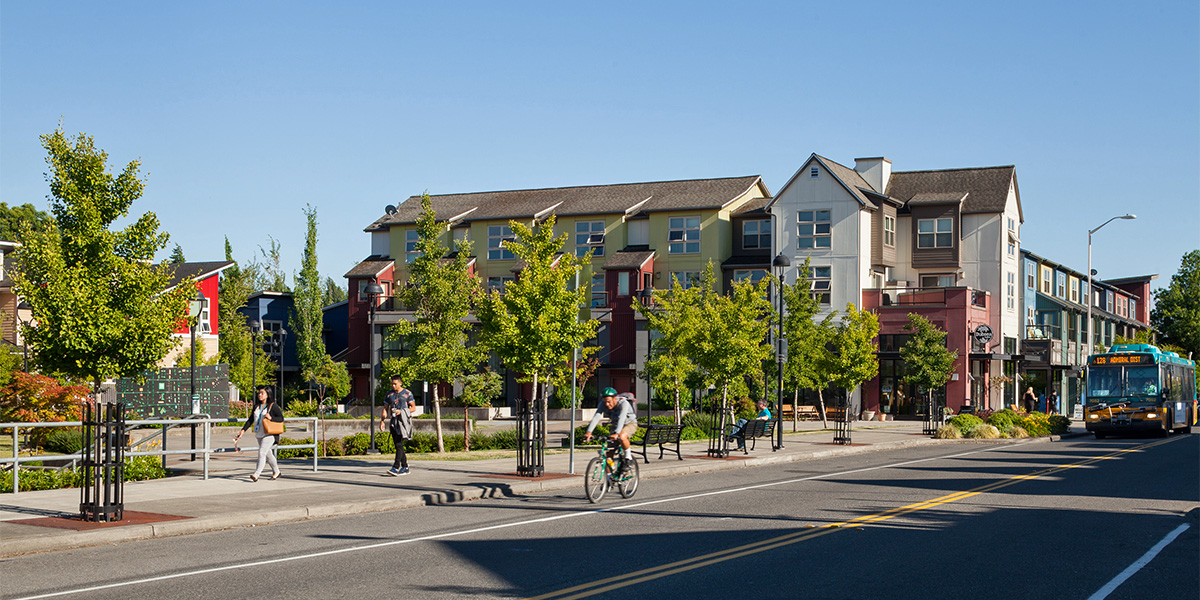
In the same way the housing authority is introducing market-rate housing to a public housing community, many cities are requiring developers to include various levels and amounts of affordable housing in new master-planned communities, such as Issaquah Highlands and Snoqualmie Ridge -- often in partnership with nonprofit groups such as Habitat for Humanity.
"In the old days, the nonprofits were suspicious of the private developers and vice versa, but they're not anymore," said Hugh Spitzer, chair of the state Affordable Housing Advisory Board. "They're all just people trying to build decent housing in an affordable way."
Next month, the advisory board will release its latest recommendations, which Spitzer says will include asking cities and counties to streamline their codes and to make it easier to develop high-density housing.