Puget Sound Business Journal: Sept. 17-23, 2004

Renting to the rich to provide for the poor

County pays for affordable housing by building market-rate apartments

Story by Greg Lamm
Staff writer

It was the dot-com heydays in the 1990s, and a real estate boom was threatening to force working-class families from their modest apartments near Bellevue as investors moved to snap up properties, spiff them up and rent them at increased prices to high-tech workers.

The King County Housing Authority stepped in, buying, refurbishing and preserving the numerous apartment complexes on the Eastside and turning many of them into "workforce" housing for families earning 40 percent to 60 percent of the area's median income. The move was crucial to helping workers afford to live near their jobs at the retail stores and other service-industry employers in the area.

But the housing authority didn't use traditional federal affordable-housing funds to do it, and the majority of housing units are not geared for very poor people who likely would be homeless without government-assisted housing.

Instead, the housing authority issued long-term bonds or teamed with private investment partners who were wooed by federal tax breaks.

The growth in private-sector investment in affordable housing comes at a time when there are serious concerns over the federal government's long-term commitment to funding and overseeing public housing programs.

That concern is prompting housing authorities to look elsewhere to buy and develop more affordable-housing projects. Under these private-sector partnerships, success is tied to the rents coming from the projects. While some rents are reduced, housing authorities have to rely more on market-rate or near market-rate rents to make the deals work.

That makes it more difficult to increase the number of housing units for the poorest of the poor.

The trend worries advocates for the homeless, who say housing authorities are ignoring a growing need for more housing to keep needy families off the streets.

Perhaps nowhere in the nation has this shift been as dramatic than in King County. In 1990, the housing authority held about 3,150 units of federally subsidized low-income housing units. During the same year, the housing authority held about 520 units of workforce housing, much of it funded under the federal Low-Income Housing Tax Credit program.

In 2004, the number of units of federally subsidized housing remains about the same, while the workforce housing has grown ten-fold to about 5,180 units.

Stephen Norman, executive director of the King County Housing Authority, said his agency is not abandoning the needs of the homeless or near homeless. Norman said the housing authority has been aggressively seeking more funding under the federal Department of Housing and Urban Development's Section 8 program, which provides rent vouchers to the very poor.

Norman also said that the workforce properties are crucial to families living in the Eastside and North King County, areas where there's an acute shortage of affordable housing. The goal, Norman said, is to avoid the mistakes of the past by heavily concentrating low-income people in neighborhoods void of good schools, public transportation, shopping and other amenities.

"This is a shift in business model, not a shift in mission," said Norman. "Our primary role is providing a housing safety net."

But just how big that safety net will be in the future concerns advocates for the homeless. John Fox, coordinator of the Seattle Displacement Council, acknowledges that there is a need for affordable housing for the working poor. But Fox said by shifting virtually all the new growth away from heavily subsidized properties, housing authorities are ignoringa growing problem of housing among the area's poorest people. Currently, there are about 80,000 households that earn less than 30 percent of the area's average median income of $23,350 for a family of four.

Fox's group also has raised the concern with the Seattle Housing Authority. In June, the group staged a boisterous rally of Yesler Terrace residents seeking to prevent a cutback in public housing units. The issue for the city's poorest citizens is crucial, Fox said, because more than 1,000 public housing units for very low-income families already have been shed as the Seattle Housing Authority redeveloped four other public housing projects.

King County has not shed its heavily subsidized public housing. But the lion's share of new investments have been in workforce housing. During the past 10 years, the King County Housing Authority has issued $200 million in bonds to fund workforce housing projects. The housing authority also has attracted $67.5 million in private equity investment under the Low Income Housing Tax Credit program, a Reagan-era incentive to encourage more private-sector investment in affordable housing.

"This is something that kind of started out slowly, but today is associated with 20 to 25 percent of all new rental housing produced in the U.S. It's enormous," said Dan Anderson, Bank of America's senior vice president for Community Development Banking.

Bank of America is one of the largest investors in the program, pouring in about $700 million a year in projects across the nation. Other big players include mortgage giants Fannie Mae and Freddie Mac. And other companies not traditionally associated with property investment also have jumped on the bandwagon to take advantage of the tax credits, including Chevron and Kimberly-Clark.

The program does not require a housing authority's participation. But more housing authorities, such as those in King County, Seattle, Portland and Vancouver, Wash., have been taking advantage of the program, setting up limited partnerships with investors and expanding their property holdings that are not subsidized by the federal government.

Typically, the housing authority will form a limited partnership with an investor motivated by the tax break. The housing authority will own 1 percent of the property, and the limited partner investor will own the remaining 99 percent. The investor provides 20 to 60 percent of the total development costs, with the housing authority tapping into other funds to cover the remaining costs. At the end of the 15-year tax-credit period, the agreement allows the housing authority to buy the property from the tax-credit investor using money generated from rents.

Overall, the King County Housing Authority has used tax credits to acquire or develop19 properties since the early 1990s, adding up to about 2,500 units. Using tax-exempt bonds, the housing authority has added another 2,100 units at 13 additional projects.

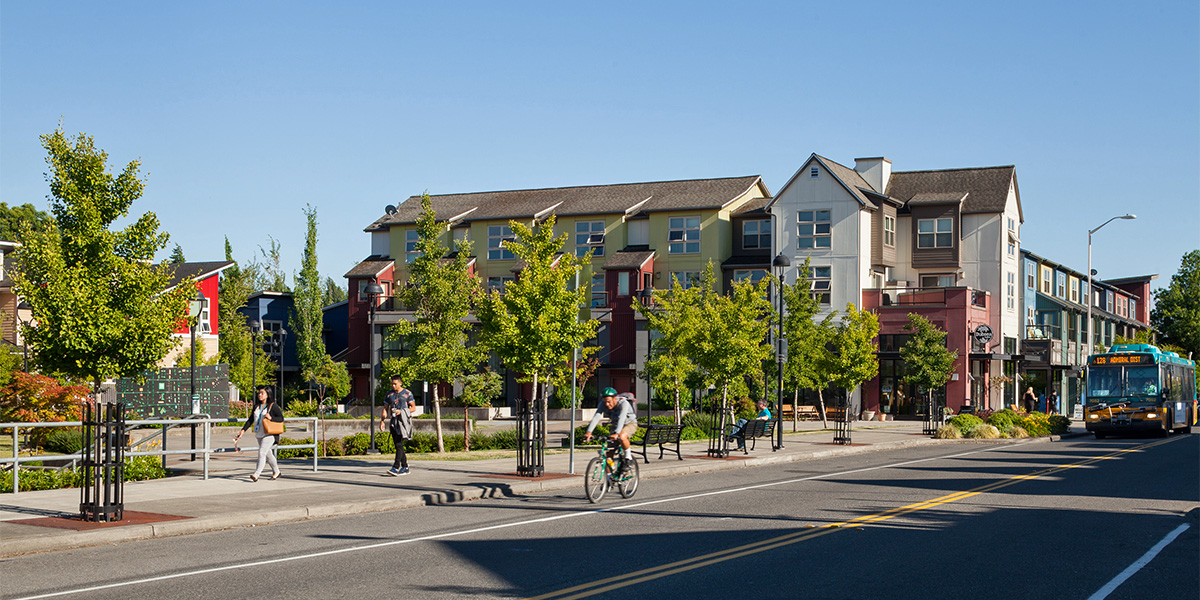
King County Housing Authority used the tax-credit investor model to develop the Village at Overlake Station, a $44 million complex of 308 moderate-income apartment units on the site of a King County Metro park-and-ride lot in Redmond. In addition to state, county and mass transit funds, the housing authority tapped into $14.5 million in tax-credit investments from Columbia Housing and Fannie Mae. And the housing authority issued $23.7 million in tax-exempt bonds underwritten by Bank of America.

Anderson said the tax-credit investments are the best way for housing authorities to increase their real estate holdings. But they are not a quick path for housing authorities looking to generate revenue to subsidize housing for the very poor. That will take years of sustainable, competent, thoughtful management of these investment properties, along with equity built up over time and continued growth in real estate markets.