King County Housing Authority
2004 Report to the Community
HOUSING IS SURVIVAL
HOUSING IS FAMILY
HOUSING IS COMMUNITY
HOUSING IS HEALTH
HOUSING IS OPPORTUNITY
HOUSING IS REGIONAL GROWTH
HOUSING IS ENVIRONMENT
Message from the King County Executive
Housing -- having a home -- underlies virtually everything that is important in our community. It is a critical element in individual health, supports strong families, creates our communities and determines patterns of regional growth.
Government's role is to both shape and assist private market efforts to step in where necessary to assure that our elderly, our disabled and our poorest households have decent affordable housing.
Shaping growth wisely and assuring adequate housing is not only the right thing to do, it offers a strategic opportunity to significantly reduce long-term human service and physical infrastructure costs borne by government. Developing housing and settlement patterns that are sustainable over the long term is the only solution to protecting the environment and quality of life in this region as we grow.
The King County Housing Authority has played a vital role in assisting local government in rising to this challenge. KCHA is unique in the nation in the degree to which it has moved beyond the traditional role of housing authorities.
Over the past five years, KCHA has sustantially expanded the safety net for the county's poorest residents. At the same time, the Authority has significantly increased its inventory of affordable housing by partnering with the private sector. Currently, over 56 percent of its housing is non-federally subsidized.
KCHA's current initiatives are leading the way in revitalizing White Center -- King County's poorest community -- and in developing facilities and services to address the needs of low-income households in South County. The Authority's success in preserving and expanding the supply of affordable housing on the suburban Eastside is critical in helping assure the equitable distribution of affordable housing across the region. Partnerships between the Authority and King County are demonstrating new models of transit-oriented development and new approaches to sustainable design and construction practices.
The County thanks the Authority's Board, executive leadership and most of all -- the staff -- who do the hard work day by day to sustain the Authority's reputation of excellence and continuing innovation. I look forward to an ongoing partnership in moving towards a future where no one in King County is without a home.
Ron Sims
Every night, over 8,000 men, women and children are homeless in King County.
And that number is growing. Housing in King County is no longer affordable for many elderly and disabled households, victims of domestic violence or unemployed families. Even households that work full time at low-wage jobs are finding it difficult to secure affordable housing. Children comprise the largest and most rapidly growing homeless population in King County.
KCHA is actively engaged in strengthening the region's housing safety net. Families that are homeless, graduating from transitional housing programs, paying more than 50 percent of their income for rent and utilities or living in extremely substandard housing receive priorityon KCHA's waiting lists for its 12,000 units of federally assisted housing.
KCHA also works with the region's human services agencies to create a network of emergency, transitional and permanent supportive housing spread across the county. KCHA currently owns and maintains 10 such facilities in partnership with local service providers.
Working with the Gates Foundation, KCHA has committed ongoing funding to support the operation of more than 200 additional units of transitional housing for homeless families. Avondale Park is one result of this partnership. A collaborative effort of Hopelink, Catholic Community Services and Friends of Youth, this model community is providing emergency and transitional housing and supportive services to 60 formerly homeless households at a time. Services include job training, counseling and childcare, as well as classes on financial planning, parenting and nutrition. When families graduate, KCHA will assist them in moving to permanent housing.
HOUSING IS SURVIVAL
KCHA believes in strengthening families, starting with our communities' youth. Many of our residents are refugees and immigrants who value academic achievement for their children but lack the skills to support them in school. Over 13,000 children live in housing supported through KCHA's programs. KCHA is committed to assuring that Head Start and childcare programs, Boys & Girls Clubs and educational facilities are available to support them.
At Springwood Apartments on Kent's East Hill, KCHA created Building Better Futures, a partnership with Kent Youth and Family Services, the Puget Sound Educational Service District and the Center for Career Alternatives, to build a 20,000-square-foot Family Center for both public housing residents and the surrounding community. Opened in the spring of 2004, the Center houses a four-classroom Head Start Program, a primary health care clinic for women and infants, and a job training, counseling and placement center. A Youth Center, providing safe supervised after-school recreation and homework assistance for older kids, will break ground next spring.
These initiatives are echoed across the county. Ten Boys & Girls Clubs and Youth and Family Services programs currently operate in KCHA communities. In White Center, KCHA has partnered with the Highline School District, the Puget Sound Educational Service District and the Southwest Boys & Girls Club to create a new community elementary school and to plan for expanded Head Start, childcare and youth facilities. In Shoreline, the Center for Human Services' after-school program has just re-opened in an expanded community center at Ballinger Homes. And in Auburn, with generous support from the city, a new Neighborhood House facility will break ground in the spring of 2005.
HOUSING IS FAMILY
Strong families are the glue of our communities and critical for the transmission of values to the next generation.
Revitalizing communities can address pockets of poverty.
Over the past several years, the Housing Authority has significantly expanded its focus to include regional planning and community revitalization issues. KCHA's housing redevelopment activities and support services now extend well beyond the borders of its public housing communities.
Nowhere is this more evident than in White Center, where KCHA has embarked on an ambitious $240 million revitalization plan. As a first step, KCHA acquired and rehabilitated The Cones and Mallard Lake, White Center's two most dilapidated and notorious apartment complexes. Working with a broad array of partners, $12 million in repairs to these properties were successfully completed in 2003. The outcome: 431 newly rehabilitated affordable housing units and two on-site community centers operated by the YWCA and Project New Futures. In a separate initiative, KCHA's Housing Repair and Weatherization Department , working with the City of Seattle, King County and local utility companies, has repaired and weatherized 110 of White Center's single-family homes.
The second stage of the Authority's vision involves the complete redevelopment of 100 acres in White Center's core. Park Lake Homes, an aging 569-unit residential complex developed for Boeing workers during World War II and subsequently converted to public housing, will be replaced by Greenbridge, a new mixed-income community of over 1,000 homes. The plan envisions a mix of incomes and housing including public housing, workforce rental apartments and affordable homeownership opportunities. The first element of the new community, the White Center Heights Elementary School, was completed in September 2004 and major infrastructure and housing construction will commence in 2005. When complete, Greenbridge will include extensive parks, a trail system, expanded childcare, youth and family support facilities, a branch library and a YWCA Center.
As part of the Greenbridge initiative, KCHA will reduce the number of public housing units in White Center, where 22 percent of KCHA's public housing for families is concentrated. These units will be replaced on a one-for-one basis with subsidized units in other areas of the county, primarily north of Seattle and on the Eastside, where the existing supply of affordable housing is extremely limited. The next generation of public housing applicants will find a broader choice of housing opportunities near entry-level job opportunities and well-resourced school systems.
HOUSING IS COMMUNITY
As a society, we will be judged by the care we take of our elderly and disabled in our midst.
For far too many seniors and people with disabilities in King County, securing affordable housing has become a real and losing struggle.
KCHA provides permanent housing for over 7,600 elderly and disabled residents in our region every night. A full 50 percent of subsidized households have a head of household who is either disabled or elderly. As many of these residents require support to continue to live independently, KCHA works with a broad partnership of community-based agencies to assure that adequate services are delivered on site.
One of KCHA's most exciting initiatives is the Housing Access and Services Program. Developed over the past five years, this innovative partnership with the county's public and behavioral health care systems has successfully housed more than 1,300 persons with disabilities in scattered-site apartments under the Housing Choice Voucher Program. Many additional seniors and people with disabilities live in KCHA's 21 mid-rise developments. To encourage a wide array of housing choices, KCHA also provides project-based Section 8 rental subsidies to nonprofits developing supportive housing across King County. One example of this is our partnership with the developmental disability community, which has enabled the creation of high-quality supported-living homes and broader housing choices outside of institutional settings.
HOUSING IS HEALTH
HOUSING IS OPPORTUNITY
The average stay in KCHA's public housing is just less than six years. KCHA's housing provides not only a home but also access to services that strengthen family stability and increase economic opportunity. KCHA has an expanding network of resident self-sufficiency initiatives and career development centers that provide services and resources for our families. These range from improved English literacy to job skills assessment, counseling, job training and placement, wage progression and quality childcare. This network of support enables many families to acquire the tools they need to become productive and self-reliant and to use subsidized housing assistance as a stepping stone to independence.
KCHA also assists both the Section 8 Housing Choice Voucher and public housing families in achieving the dream of homeownership. Building on KCHA's award-wining program at Young's Lake Commons, which enables 58 percent of participating public housing families to purchase homes within three years, new homeownership approaches are being expanded system-wide. KCHA helps residents in resolving credit issues, developing financial management skills, saving for a down payment and addressing other barriers to homeownership. The completion of Greenbridge will offer another resource: nearly 100 homes will be available for purchase by families earning between 60 percent and 80 percent of the area median income, making them affordable to many former public housing residents.
The incomes of families in public housing increase an average of 12 percent a year during the first five years in public housing.
How we grow is how we live.
HOUSING IS REGIONAL GROWTH
A healthy regional economy will inevitably spur population growth. How can we accommodate this growth and at the same time preserve all the reasons why the Puget Sound region is a great place to live? We need to grow "smart."
Smart growth is the opposite of sprawl. It involves a more integrated, and sometimes denser, approach to development that provides people with more choices in housing, shopping, communities and transportation. By placing multiple uses in proximity to one another, smart growth accommodates the population increases necessary to support economic prosperity while protecting the environment, reducing infrastructure costs and creating great places to live, work and play.
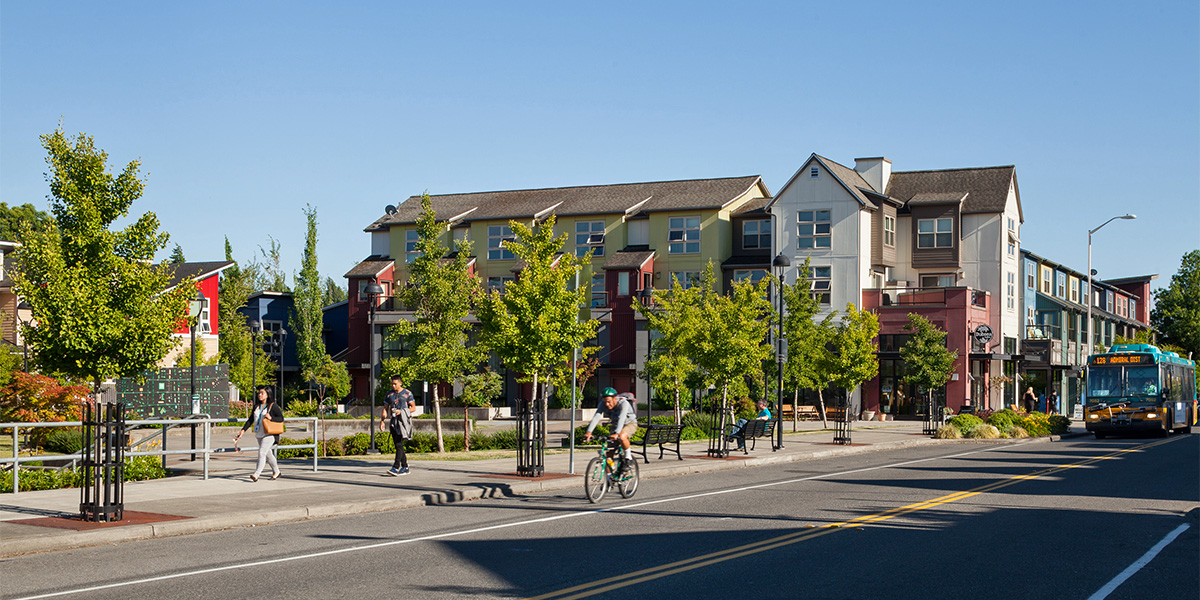
The Village at Overlake Station, KCHA's most recent development in Redmond, integrates 308 units of attractive workforce housing, mass transit and a childcare center on a single site. Overlake Station provides affordable housing for the area's growing employment needs and helps ease traffic congestion and regional sprawl. A tenant at Overlake can literally step out the front door, drop their child at quality childcare and then proceed to the on-site bus transit center or walk to many nearby stores and businesses.
Over the past six years, KCHA has acquired or developed 12 additional apartment complexes with 2,029 units of workforce housing to help assure a continued supply of high-quality affordable housing near job centers, with a particular focus on the region's more affluent suburbs.
A good example is Somerset Gardens in Bellevue, where large households and working families enjoy affordable apartment homes near jobs and services. Located in a top school district, children in this community benefit from exceptional educational opportunities while their parents commute short distances to jobs in the Bellevue community.
HOUSING IS ENVIRONMENT
Sustainable development and environmental stewardship are key to the future of our region.
KCHA is committed to sustainable business practices that contribute to the long-term protection and enhancement of our environment, our economy and the health of current and future generations. The Authority integrates environmental considerations into decisions regarding purchasing, operations, building design, construction, and waste management. Such strategies are yielding impressive results in terms of energy and water consumption, as well as significant cost savings. As a result of our efforts, we are reducing operational expenses while improving the sustainability of our housing stock.
KCHA focuses on creating livable communities where residents can walk or take public transportation to jobs and services. Increasingly, "green" building principles are incorporated into repair and modernization efforts. In the past year, for example, we have replaced more than 1,000 toilets in residential units with "low-flow" models and created an in-house Energy Savings Corporation (ESCO) to pay for further energy-saving improvements in our public housing communities.
Working in partnership with King County, KCHA has developed new, innovative approaches to master plan development at Greenbridge. This 100-acre redevelopment initiative reflects the region's growing environmental sensitivity. Biofiltration swales, water quality retention vaults and wetponds will improve storm water quality. BuiltGreen construction principles, which emphasize recycled materials, energy efficiency and drought tolerant landscaping, as well as open spaces and trails, are integral to design and construction plans.
Mission: "We provide quality affordable housing opportunities and build communities through partnerships. We encourage self-sufficiency, and we protect the dignity of people with limited resources while safeguarding the public trust."
The King County Housing Authority administers a broad range of federally and locally financed housing programs serving the region's housing needs. KCHA's operationss encompass an area of over 2,000 square miles, covering all of King County outside the cities of Seattle and Renton. The Authority also serves as the management agent for the Housing Authority of the City of Sedro-Woolley in Skagit County.
The King County Housing Authority was created in 1939 and operates pursuant to the State of Housing Authorities Law (RCW 35.82) and the Housing Cooperation Law (RCW 35.83). The Authority is an independent municipal corporation created specifically to provide affordable housing and related services.
The Authority is overseen by a Board of Commissioners appointed by the King County Executive and approved by the Metropolitan King County Council.
The King County Housing Authority owns or controls over 8,900 units of housing and provides rental subsidies to 8,400 additional households. The majority of KCHA's program participants have incomes below 20 percent of the area's median income. KCHA's inventory includes 3,372 units of public housing. The Authority has been rated a "high performer" by the federal Department of Housing and Urban Development (HUD) since the institution of national rating systems. KCHA's current score of 97.2 percent under the Public Housing Assessment and 96 percent under the Section 8 Management Assessment Program are among the highest in the nation for a large housing authority.
PROGRESS REPORT 2004
KCHA's housing assistance programs have expanded by 60 percent over the past six years. KCHA currently supports over 17,300 households in quality affordable housing.
Much of this growth has been funded through long-term bonds issued by the Authority, or through equity contributed by private investors under the Low Income Housing Tax Credit Program. Over the past decade, KCHA has issued more than $200 million in bonds and leveraged $67.5 million in private equity investments to fund acquisition, rehabilitation and development initiatives. Green River Homes in Auburn and Harrison House in Kent are being upgraded under the tax credit program in 2004/2005.
The Authority helps fund the development of additional affordable housing by community-based nonprofit organizations. KCHA has provided $49 million in conduit financing to support locally developed projects. This year, KCHA will provide $19.5 million in financing to support three new affordable housing developments in the county.
In partnership with local governments and the utility companies, KCHA also provides weatherization and housing repair assistance to low-income homeowners and privately owned affordable housing. Over the past five years, KCHA has invested $16.9 million to upgrade 2,850 privately owned units, including 1,100 single-family homes.
KCHA has continued its tradition of excellence in the management and maintenance of its public housing inventory. Our residential communities are considered some of the best in the country. Waiting lists for public housing are at an all-time high, and occupancy of our available units is at 98 percent. Over the past five years, $32 millionhas been invested in upgrading building systems, renovating apartment interiors, addressing surface water management issues and improving building envelopes.
As part of its Capital Plan, KCHA is currently installing fire sprinkler systems and state-of-the-art fire alarm and communication systems in 21 mid-rise buildings for seniors and households with disabilities. Newly refurbished common areas, new furniture, signage and other site enhancements are simultaneously improving both the attractiveness and safety of this critical element of the housing inventory.
KCHA is shifting its in-house property management approach to a site-based model that more closely resembles private sector models. A pilot program, involving 20 percent of the Authority's public housing operations, will begin by the end of 2004.
KCHA is a participant in HUD's Moving to Work (MTW) initiative. MTW enables designated housing authorities to better respond to local needs and priorities by developing new policy and program approaches outside of HUD's regulations. MTW has enabled KCHA to significantly streamline the process for project-basing Section 8 Housing Choice Vouchers, to begin adjusting admission and rent policies and to develop additional internal operating efficiencies.
The Section 8 program has grown by 3,920 units over the past five years. Much of this growth has focused on providing additioal resources to households with special needs, including project-basing Housing Choice Vouchers to assist in the development of transitional and permanent supportive housing. KCHA contracts with over 3,000 landlords in the region and is an integral part of the local economy.
As part of its regional role, KCHA actively promotes the equitable distribution of affordable housing across the county. The redevelopment of Park Lake Homes will enable KCHA to reduce the over-concentration of public housing in White Center. Working in partnership with A Regional Coalition for Housing (ARCH), the Authority has committed to one-for-one replacement of the 269 units of public housing not being rebuilt on site with new subsidized housing opportunities in North and East King County. The first units of replacement housing are already occupied.
KING COUNTY HOUSING AUTHORITY
600 ANDOVER PARK W., SEATTLE, WA 98188
WWW.KCHA.ORG